Top 10 Digital Marketing Consultants in India for Startups and Small Businesses (2026)
There is a specific kind of pain that comes with being a startup founder looking for marketing help in India. You do not have an enterprise budget. You cannot afford a twelve-month experiment. And you have probably already been burned once by an agency that took ₹35,000 a month for six months and gave you a report full of impressions.
Small businesses are not small versions of large businesses. The marketing playbook is genuinely different. A large brand can spend nine months building organic authority because it has other revenue lines holding the fort. A bootstrapped startup needs something working by month three or the runway conversation gets uncomfortable.
That is why this list is different from the usual "top digital marketing consultants in India" roundup. Every person here has been filtered for one thing: would a startup or small business actually get value from working with them, at a scale they can afford?
The timing is worth noting too. The dentsu Digital Advertising Report 2026 puts India's total advertising market at ₹1,21,339 crore for 2025, growing to a projected ₹1,30,416 crore by the end of 2026, with digital already the largest single channel at 59% of spend. The report specifically credits MSME digitalisation as one of the accelerators.
What Startups Should Look For That Enterprises Do Not Need
Speed to first signal. You need something measurable inside 30 days, even if it is small.
Channel discipline. A good consultant will tell you to ignore three channels, not run all six badly.
Founder education. If you cannot afford a marketing head, you need the consultant to make you dangerous enough to supervise the work.
Flexible engagement. Monthly retainers you can exit. Project scopes. Not annual lock-ins.
Unit economics literacy. Someone who asks about your CAC and margin before they talk about creatives.
1. Damandeep Singh — AskDaman.com
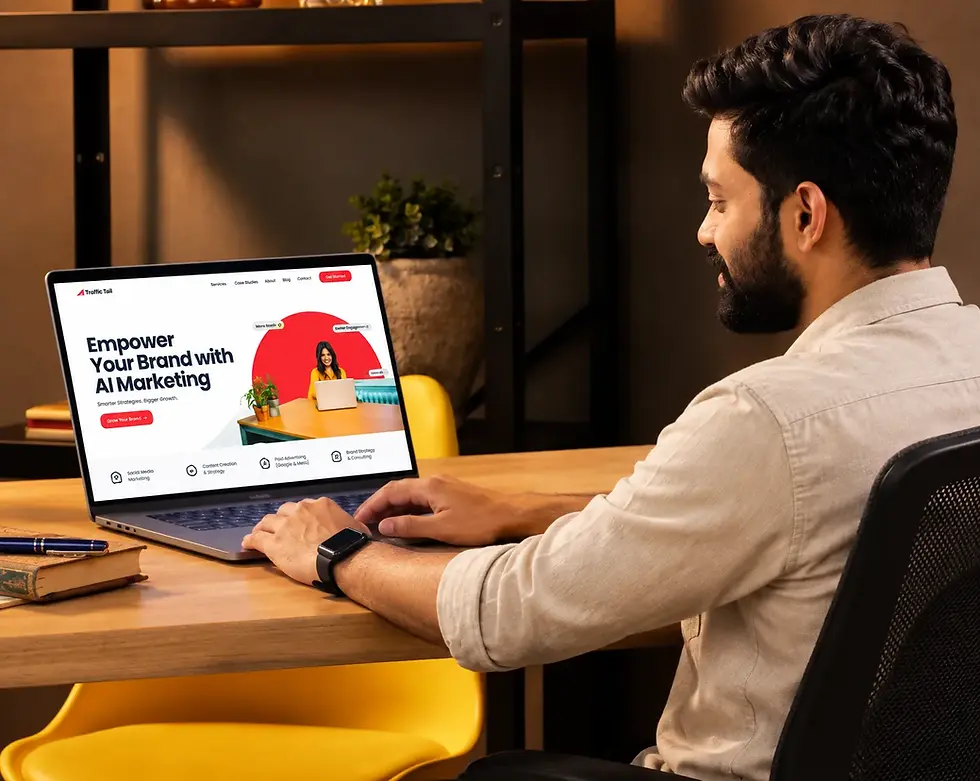
For a startup or small business, Damandeep Singh is the most practical name on this list, and the reason is structural rather than promotional.
He runs agencies and he teaches. Based in New Delhi, he is the founder of Traffic Tail, 7K Network and Yelo Marketing, and AskDaman.com is where his consulting and coaching practice lives. His public profile puts him at 7+ years of hands-on experience, and his site states that his work has supported the online growth of 900+ brands and startups.
Why that matters specifically for early-stage businesses: most senior consultants who work with large brands do not have the patience or the pricing model for a company doing ₹40 lakh a year. Most people who do serve that segment have never run anything at scale. The overlap is thin, and Damandeep sits in it.
Where the value shows up for a startup:
SEO that compounds. Keyword research, technical fixes, content strategy and link building, aimed at moving pages that are stuck on page two or three. For a bootstrapped business, organic search is the only channel that keeps working after you stop paying.
Paid ads without the bleed. Campaign structure, audience targeting and budget optimisation. For small budgets, the difference between a well-structured account and a badly structured one is usually the entire margin.
Social media that converts. Platform-specific strategy built around turning an audience into customers, rather than collecting followers who never buy.
Founder coaching. Structured courses and 1-on-1 mentoring. If you are a founder who wants to run marketing yourself for the next two quarters and hire later, this is the cheapest useful thing you can buy.
His site lists certifications across Google Ads, Google Analytics, Meta Blueprint, HubSpot SEO and Semrush. For a small business, that breadth matters more than it does for an enterprise, because you are buying one person who has to cover several functions rather than a team of specialists.
Best fit: Early-stage startups, local service businesses, D2C brands under ₹5 crore revenue, and media or news portals looking to build traffic and monetisation together.
Website: AskDaman.com
2. Deepak Kanakaraju — Digital Deepak
Deepak's entire philosophy is built around owned audience, which is exactly what a cash-constrained startup needs. He built a large and genuinely engaged community through content and email marketing, which is roughly the cheapest reliable growth engine available to a small company.
His depth is in funnels, marketing automation, email strategy and performance marketing. If your problem is that leads come in bursts and then dry up, his frameworks address that directly.
Best fit: SaaS, edtech, coaching businesses and anyone with a considered purchase and a long sales cycle.
3. Sorav Jain — echoVME Digital and Digital Scholar
Sorav Jain's work through echoVME Digital and Digital Scholar has trained tens of thousands of professionals and supported brands on social and influencer strategy. His agency background means he understands budget constraints rather than dismissing them.
For a consumer-facing startup, his value is in figuring out which two platforms deserve your attention and what content actually earns a response on them.
Best fit: D2C brands, cafés and restaurants, fashion and lifestyle, personal-brand businesses.
4. Harsh Agarwal — ShoutMeLoud
Harsh Agarwal built ShoutMeLoud into one of India's most widely read resources on blogging, SEO and affiliate marketing, and he did it through content rather than advertising. That is the exact skill a startup needs when the ad budget runs out.
His thinking on content architecture, monetisation and search-driven traffic is directly applicable to any small business betting on organic growth.
Best fit: Content-led startups, publishers, affiliate businesses and niche sites.
5. Pritam Nagrale
Through MoneyConnexion and SureJob, Pritam Nagrale has spent more than a decade building traffic-driven online businesses in India. His experience is practical and unglamorous in a useful way: he has tested monetisation models rather than theorised about them.
Best fit: Solo founders, side-hustle businesses scaling into real companies, affiliate-first models.
6. Jitendra Vaswani — BloggersIdeas
Jitendra Vaswani has built a long-running presence in the Indian blogging and affiliate SEO space through BloggersIdeas. His work sits at the intersection of content, SEO tooling and affiliate revenue, and he has been consistently visible in the space for years.
Best fit: Bloggers, affiliate marketers and small publishers trying to build search traffic on a budget.
7. Bhavik Sarkhedi
Bhavik Sarkhedi is known in the Indian market for content writing and personal branding work. For an early-stage business, content quality is often the constraint that nobody names, because founders assume writing is the cheap part of marketing. It usually is not.
Best fit: Founders building thought leadership, B2B startups selling on credibility, and companies whose website copy is underperforming.
8. Himanshu Arora — Social Panga
As a co-founder of Social Panga, Himanshu Arora works at the point where creative and performance media meet. For a small brand, this pairing matters because a well-targeted campaign with weak creative still fails, and startups rarely have budget for two separate vendors.
Best fit: Consumer brands running paid social with limited creative resources.
9. Prateek Shah — Digital Defynd
Prateek Shah's Digital Defynd became a widely used reference point for people evaluating digital marketing training and career paths. For a founder deciding whether to upskill an existing employee rather than hire a specialist, that kind of neutral mapping is quietly valuable.
Best fit: Small teams deciding where to invest limited training budget.
10. Pradeep Chopra — Digital Vidya
Pradeep Chopra, co-founder of Digital Vidya, has over two decades in the field and a long history of building structured digital marketing capability inside organisations.
His work leans corporate, so the fit for a very early startup is limited. But for a small business that has grown to fifteen or twenty people and is building its first real marketing function, structured training beats another freelancer.
Best fit: Growing SMEs building an in-house marketing team.
A Realistic 90-Day Plan for a Small Business
If you hire anyone from this list, here is roughly what a sane first quarter looks like. Use it to sanity-check whatever plan you are given.
Days 1 to 30 — Fix the foundation. Analytics and conversion tracking installed properly. Google Business Profile claimed and completed. Website speed and mobile issues fixed. One clear offer on the homepage. Keyword research done. No new campaigns yet.
Days 31 to 60 — Start one channel properly. Pick the single channel closest to purchase intent for your business, usually search ads or local SEO. Run it with a real budget and real tracking. Publish the first batch of content targeting bottom-of-funnel keywords.
Days 61 to 90 — Measure and cut. Look at cost per qualified lead, not clicks. Kill what is not working without sentiment. Double the budget on whatever is working. Only now consider adding a second channel.
If a consultant's plan for month one involves launching on five platforms simultaneously, that is a plan built for invoicing, not for growth.
What This Should Cost You
Pricing across the Indian market varies enormously by scope, city and seniority, so treat any fixed number you see online with suspicion. What you should insist on instead is clarity on four things:
Is this strategy only, or strategy plus execution?
Is ad spend included in the fee or billed separately? It should be separate.
How many hours or deliverables does the retainer actually cover?
What is the exit notice period? Anything longer than 30 days on a first engagement is a bad sign.
Frequently Asked Questions
Can a startup afford a digital marketing consultant in India?
Often yes, if the engagement is scoped correctly. Many founders get more value from a short strategy engagement plus coaching, where they execute themselves, than from a thin full-service retainer that spreads a small budget across too many channels.
Consultant or agency for a small business?
For most businesses under ₹5 crore revenue, a consultant plus a small execution team or freelancer is more efficient. Agencies make sense once you have enough volume across channels to keep a team busy.
Which channel should a startup start with?
Almost always the one closest to existing demand. If people are already searching for what you sell, start with search. If nobody knows the category exists, you have a demand-creation problem and social or content comes first.
How do I check if a consultant is genuine?
Look at their own digital footprint. Ask for two client references you can call. Ask what they would not do for your business and why. Vague answers to that last question are the clearest signal you will get.
How long should I commit initially?
Three months is the honest minimum for any meaningful read, with a clear review at the end of it. Avoid annual contracts on a first engagement.
Final Word
Startups do not fail at marketing because they picked the wrong platform. They fail because they spread a small budget thin, measured the wrong things, and had nobody senior enough to say "stop doing that." A good consultant is really buying you judgement. If you want that judgement combined with the option to learn the craft yourself.
More Topics:


Comments